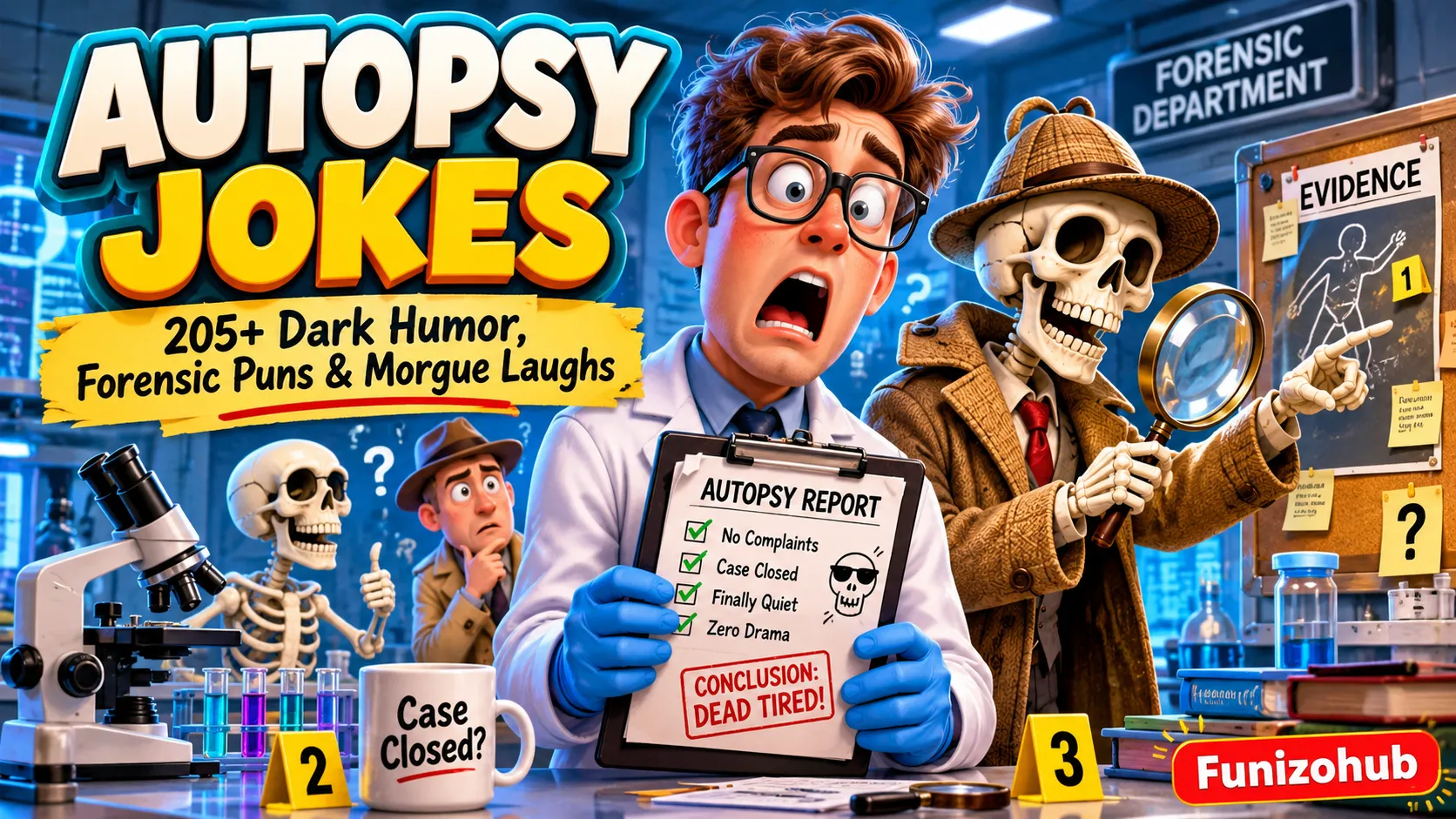
Autopsy Jokes: Some jokes are best left unexplained. Others need a closer examination. Autopsy humor takes a dark, clinical subject and turns it into unexpected comedy through deadpan observations, forensic wordplay, and absurd situations. The trick is to make the punchline clever rather than graphic.
From sarcastic coroners to suspiciously quiet patients, these autopsy jokes use a different style of humor: dry, witty, occasionally ridiculous, and just a little unsettling.
What Is Autopsy Humor?
Autopsy Humor is a form of dark or macabre comedy that uses the language, setting, and professional routines associated with postmortem examinations as material for jokes. It can include coroner wordplay, forensic puns, dry observations, and exaggerated workplace situations.
The style doesn’t have to rely on graphic imagery or disrespectful jokes about real tragedies. Much of its humor can come from the contrast between a serious professional environment and ordinary frustrations, such as paperwork, office meetings, or overconfident detectives.
Quick Category Overview
| Category | Best For |
| Dark Autopsy Jokes | Dark humor fans |
| Coroner Jokes | Dry professional humor |
| Forensic Puns | Clever wordplay |
| Morgue One-Liners | Short, deadpan comedy |
| Medical Examiner Jokes | Workplace humor |
| Autopsy Report Jokes | Mock-serious observations |
| Detective and Autopsy Jokes | Mystery humor |
| Scientific Dark Humor | Clinical comedy |
| Unexpected Autopsy Jokes | Absurd punchlines |
| Autopsy Dad Jokes | Corny medical humor |
| Autopsy Q&A Jokes | Quick punchlines |
| Autopsy Short Stories | Mini comedy scenes |
Dark Autopsy Jokes
These jokes approach the subject with a straight face and an unexpected punchline. The humor comes from the contrast between a serious examination and an absurd conclusion.
- The autopsy report was surprisingly positive. The patient had finally stopped complaining.
- The coroner said the case was straightforward. For once, nobody had anything to say.
- The examiner asked for a second opinion. The first one was a little too quiet.
- The autopsy revealed a shocking discovery: the situation was beyond repair.
- The coroner loved honest patients. They never interrupted his conclusions.
- The report said the subject had a peaceful expression. Apparently, the meeting had finally ended.
- The examiner called the case a closed book. Nobody was turning another page.
- The coroner had excellent timing. He always delivered his conclusions after the final silence.
- The investigation was going nowhere, but at least nobody was rushing the process.
- The examiner said he had seen worse. His coworkers stopped asking what that meant.
- The report was short, factual, and completely lacking in feedback.
- The coroner’s favorite cases were the ones without complicated follow-up questions.
- The examiner said the evidence spoke for itself. It was the quietest witness he’d ever interviewed.
- The case was officially finished. It had reached its final chapter.
- The coroner called it a difficult day at work. Nobody laughed at his jokes, either.
Best for: Readers who enjoy dry, understated dark humor without graphic descriptions.
Coroner Jokes With a Deadpan Twist
A coroner’s job is serious, which makes the profession an ideal setting for straight-faced comedy. These jokes rely on sarcasm, office humor, and unusually literal observations.
- Why did the coroner avoid office gossip? He Preferred Facts Over Rumors.
- The coroner’s performance review said he was excellent at reaching conclusions.
- Why was the coroner calm during emergencies? He had learned not to jump to conclusions.
- The coroner never rushed a report. He believed every case deserved a thorough ending.
- His coworkers called him the office closer. He always finished what others couldn’t.
- Why did the coroner dislike brainstorming meetings? Too many people had theories and not enough evidence.
- The coroner’s favorite phrase was, “Let’s look at the facts.” His least favorite was, “I saw it on social media.”
- Why was the coroner good at solving puzzles? He always examined every piece.
- The coroner kept his desk organized because his cases were complicated enough.
- His calendar was full of appointments that nobody wanted to discuss over lunch.
- Why did the coroner dislike vague instructions? He preferred a clear conclusion.
- The coroner’s emails were always concise. He had no time for unnecessary details.
- His boss said he needed more enthusiasm. He replied, “I’ll look into it.”
- Why did the coroner love paperwork? It was the only thing at work that kept coming back.
- The coroner had a dark sense of humor, but his reports were always professional.
Best for: Workplace comedy, deadpan jokes, and readers who appreciate understated sarcasm.
Forensic Puns That Need Closer Examination
Forensic science has plenty of technical language that can be turned into wordplay. These jokes use evidence, analysis, and investigation as the foundation for their punchlines.
- The forensic scientist had a strong case, but the evidence needed a little more support.
- I wanted to make a forensic pun, but the evidence didn’t support it.
- The lab technician was great at finding clues. She had a real talent for picking things apart.
- The investigation was going well until the facts became suspicious.
- The forensic team never guessed. They preferred to let the evidence make its case.
- My detective story needed more forensic detail. The plot was getting away with too much.
- The scientist examined the evidence twice. She didn’t want to make a premature conclusion.
- The lab was full of bright minds and questionable samples.
- Why did the forensic analyst get promoted? She always left a trace of excellence.
- The detective loved chemistry because every good mystery needed a reaction.
- The evidence was inconclusive. Even the clues needed more information.
- The scientist’s favorite music was anything with a good sample.
- Why did the investigator bring a notebook? To keep track of all the little details.
- The lab’s motto was simple: trust the data, question the assumptions.
- The case was so complicated that even the facts requested a second opinion.
Best for: Science enthusiasts, forensic-themed content, and readers who enjoy clever wordplay.
Morgue One-Liners
Short, sharp, and deliberately uncomfortable, these one-liners deliver their punchlines with almost no setup.
- The morgue is the quietest workplace in town.
- My coroner friend never takes criticism personally. He just examines the facts.
- The night shift has very little small talk.
- In forensic work, the last word belongs to the report.
- The morgue’s customer feedback system is unusually quiet.
- I asked for a lively discussion. Wrong Department.
- The examiner believes in finishing every case before calling it a day.
- The office has a strict no-running policy. Nobody is going anywhere.
- The coroner’s calendar is full, but the meetings are remarkably calm.
- In this profession, silence is not always awkward.
- The report had a strong conclusion and absolutely no sequel.
- The morgue coffee is so strong it could wake up the entire building. Almost.
- The examiner’s humor is so dry it should come with a warning label.
- The office motto: keep a cool head and follow the evidence.
- Some jobs involve customer service. This one involves considerably less conversation.
Best for: Dark humor captions, quick laughs, and short-form comedy posts.
Autopsy Report Jokes
Official reports are supposed to be objective and precise. Imagine how funny they would sound if they included brutally honest office-style commentary.
- Finding: The subject showed no interest in participating in the interview.
- Conclusion: The meeting was officially over, with no requests for follow-up.
- Observation: The room was quiet. The team appreciated the lack of interruptions.
- Case status: Closed, unlike the office door that someone forgot to shut.
- Additional note: The examiner’s coffee was more active than the morning shift.
- Final remark: The evidence was clear; the paperwork was not.
- Report summary: A complicated case made even more complicated by three different filing systems.
- Recommendation: The department should invest in better printers.
- Finding: The case contained more unanswered questions than the team’s group chat.
- Administrative note: The report was complete, but the software required another update.
- Conclusion: All available evidence was reviewed, including the coworker’s questionable theory.
- Observation: The case was difficult, but the office Wi-Fi was worse.
- Final note: The examiner requests fewer meetings and more accurate forms.
- Case review: The facts were straightforward. The office discussion was not.
- Closing statement: The report is final. Suggestions about the font can be sent to management.
Best for: Mock reports, forensic memes, and office-style dark comedy.
Detective and Autopsy Jokes
Mysteries become funnier when detectives arrive with dramatic theories and the medical examiner responds with nothing but facts.
- The detective announced he had a brilliant theory. The examiner asked if it included evidence.
- “I’ve solved the case!” said the detective. “Excellent,” replied the examiner. “Now solve the paperwork.”
- The detective wanted a dramatic reveal. The examiner wanted a completed form.
- Why did the examiner dislike detective novels? Everyone reached conclusions before checking the facts.
- The detective suspected everyone. The examiner suspected the detective needed sleep.
- “Was it foul play?” asked the detective. “Your questioning certainly is,” replied the examiner.
- The detective arrived with ten theories and one coffee. The examiner ordered another coffee.
- The investigator called the case a mystery. The examiner called it Tuesday.
- The detective demanded answers. The examiner asked for better questions.
- The detective’s notebook was full of clues. The examiner’s was full of corrections.
- Why did the examiner refuse to guess the culprit? Speculation wasn’t in the job description.
- The detective wanted a confession. The examiner wanted everyone to stop interrupting.
- The detective dramatically pointed at the evidence board. The examiner pointed at the missing labels.
- “This case has so many twists!” said the detective. “So does the printer paper,” replied the examiner.
- The mystery was nearly solved until the detective watched another crime documentary.
Best for: Mystery Lovers, detective humor, and jokes about forensic investigations.
Scientific Dark Humor
Science depends on observation, evidence, and careful conclusions. Add a little deadpan humor, and even a laboratory can become a comedy setting.
- The scientist said the results were conclusive. The coffee machine remained under investigation.
- Why did the lab team stay calm? They refused to react without evidence.
- The experiment failed, but the report called it an unexpected learning opportunity.
- The researcher wanted a breakthrough. The equipment wanted a software update.
- The lab’s most mysterious substance was the liquid nobody remembered labeling.
- Why did the scientist distrust assumptions? They had a poor track record in peer review.
- The research team reached a conclusion, then spent two hours debating the wording.
- The experiment produced fascinating results and a very confusing spreadsheet.
- The scientist’s favorite phrase was, “Let’s replicate that.” The budget disagreed.
- The data was perfectly clear until someone opened it in the wrong software.
- The lab technician called the day productive because nothing caught fire.
- The researcher had a dark sense of humor and a very bright microscope.
- Why did the scientist love statistics? Numbers rarely interrupted presentations.
- The experiment was a success, according to the person who designed it.
- The team documented everything, especially the mistakes nobody wanted to repeat.
Best for: Science humor, laboratory memes, and readers who enjoy intellectual comedy.
Unexpected Autopsy Jokes
The best absurd humor takes a serious situation and introduces something completely ordinary. These jokes turn forensic work into a series of bizarre workplace moments.
- The autopsy room was perfectly organized, except for the examiner’s lunch labeled “Do Not Touch.”
- The coroner was investigating a mysterious case when the office printer jammed. Suddenly, that was the real emergency.
- The examiner prepared for a long day, bringing coffee, snacks, and a backup stapler.
- The detective expected a shocking revelation. Instead, the examiner explained the filing system.
- The laboratory introduced a new productivity app. Nobody could find the login.
- The examiner asked for silence, but the vending machine refused to cooperate.
- The report was almost finished when the computer asked whether to install updates.
- The team finally solved the mystery of the missing pen. It was behind someone’s ear.
- The coroner’s biggest fear wasn’t a difficult case. It was a mandatory team-building exercise.
- The forensic lab installed a smart speaker. Its first question was, “Why is everyone whispering?”
- The examiner had a perfectly serious presentation, ruined by a slide titled “Miscellaneous Stuff.”
- The detective wanted dramatic music for the reveal. The office computer played a notification sound.
- The lab’s new assistant labeled every folder “Important.” The filing cabinet became a mystery of its own.
- The examiner said the case was unusual. Then the office microwave started beeping.
- The investigation was complete, but nobody knew who had finished the last of the coffee.
Best for: Absurd humor, unexpected punchlines, and readers who prefer quirky comedy over graphic jokes.
Explore More: https://funizohub.com/fortune-cookie-jokes/

Medical Examiner Jokes About Work
Medical examiners handle demanding responsibilities, so this section focuses on fictional workplace frustrations rather than the details of real examinations.
- The medical examiner’s work calendar had more deadlines than daylight.
- Why did the examiner carry two pens? One always disappeared during paperwork.
- The office printer was the only thing that consistently refused to cooperate.
- The examiner asked for a quiet afternoon. Management scheduled a conference call.
- Why did the medical examiner love checklists? They were the only coworkers who stayed on topic.
- The morning briefing lasted ten minutes. The discussion about the briefing lasted forty.
- The examiner’s desk was organized, except for the mysterious pile marked “Later.”
- The new computer system promised efficiency. It required three passwords and a tutorial.
- The examiner took a lunch break, but the email notifications did not.
- The team celebrated finishing the report by discovering another form.
- Why did the examiner enjoy Fridays? Even the paperwork seemed slightly more optimistic.
- The department introduced flexible scheduling. Everyone flexed their eyebrows.
- The examiner’s professional development goal was to stop saying “just one more thing.”
- The office had excellent teamwork, especially when everyone agreed to blame the printer.
- The examiner finished early and immediately received a meeting invitation.
Best for: Workplace memes, medical professionals, and office comedy with a forensic theme.
Autopsy Dad Jokes
These jokes are intentionally corny. They rely on simple puns, predictable wordplay, and the kind of punchlines that make people groan before they laugh.
- Why was the coroner good at conclusions? He always got to the bottom of things.
- What did the examiner say about his favorite report? It was a dead giveaway.
- Why did the forensic scientist bring a ruler? To measure the evidence.
- What is a coroner’s favorite type of story? One with a definitive ending.
- Why did the detective bring a pencil? In case he had to draw a conclusion.
- What do you call a very calm examiner? Deadpan professional.
- Why did the lab technician get a promotion? She was outstanding in her field.
- Why was the report so popular? It had a killer conclusion.
- What did the examiner say about the difficult case? “It’s a long story, but the ending is final.”
- Why did the scientist love notebooks? They helped keep everything in line.
- What is a forensic analyst’s favorite game? Clue.
- Why did the coroner bring an umbrella? The forecast called for a dark outlook.
- Why did the report go to school? It wanted to improve its findings.
- What did the detective call a predictable mystery? A case of déjà clue.
- Why was the examiner so good at editing? He knew when to cut to the facts.
Best for: Corny humor fans, harmless dark jokes, and wordplay enthusiasts.
Autopsy Q&A Style Jokes
These quick exchanges use the setup of a serious professional question and a punchline that takes the conversation somewhere ridiculous.
- Why did the examiner bring a notebook? To record everything, including the bad jokes.
- What does a coroner call a finished case? A conclusion with no sequel.
- Why did the detective ask for another opinion? His first theory was mostly dramatic music.
- What’s the quietest part of the lab? The moment everyone realizes the printer is broken again.
- Why did the scientist double-check the results? The first spreadsheet looked suspicious.
- What is a coroner’s least favorite phrase? “Can we circle back?”
- Why was the report so brief? The writer had a strict word count.
- What did the examiner say to the overconfident detective? “Show me the evidence.”
- Why did the lab technician bring snacks? Research takes a lot of crunch time.
- What’s the biggest mystery in the office? Who keeps changing the thermostat?
- Why did the examiner hate vague emails? There was no clear conclusion.
- What did the detective say after solving the case? “Now, where’s my coffee?”
- Why was the scientist so patient? Good results take time.
- What did the examiner think of the new software? It had potential, if only it would open.
- Why did the team celebrate? They finally submitted the correct version of the report.
Best for: Short exchanges, quick joke posts, and readers who enjoy punchline-driven comedy.
Autopsy Short Stories
These mini-scenes use dialogue and everyday absurdity to create a different kind of forensic humor.
The Final Report
The examiner finished typing a detailed report and leaned back.
“Everything complete?” asked the detective.
“Yes.”
“Any unresolved issues?”
“One.”
“What is it?”
“The computer wants me to save my changes.”
The detective nodded gravely. “The most dangerous development of the day.”
The Second Opinion
A detective rushed into the office.
“I need a second opinion immediately!”
The examiner looked up from his paperwork. “About the evidence?”
“No. About whether this tie makes me look like a serious investigator.”
The examiner studied it carefully.
“I’d say the tie is inconclusive.”
The Missing Evidence
The team spent an hour searching for an important folder.
“Have we checked everywhere?” asked the supervisor.
“Everywhere,” said the assistant.
The examiner opened the filing cabinet and found it immediately.
“How did you do that?” the detective asked.
“I looked in the cabinet labeled ‘Files.'”
Everyone wrote that down as a breakthrough.
The Coffee Investigation
The examiner entered the break room and found an empty coffee pot.
“Who finished it?” he asked.
Nobody answered.
The detective opened his notebook. “We have a mystery.”
The examiner sighed. “At last, a case with a motive everyone understands.”
The Unexpected Conclusion
The detective stood before the team.
“After days of investigation, I have reached a conclusion.”
Everyone leaned forward.
“The real culprit behind our delays…”
He paused dramatically.
“…is the printer.”
The examiner nodded. “Finally, a theory supported by years of evidence.”
Best for: Readers who enjoy dialogue, miniature comedy scenes, and forensic humor with an absurd twist.
Why Does Dark Forensic Humor Use Deadpan Delivery?
Deadpan delivery means presenting a joke in a calm, serious, or emotionless manner. In forensic-themed comedy, that style can make a punchline more unexpected because the speaker sounds as though they’re delivering an official conclusion rather than a joke.
Three common techniques include:
- Professional understatement: Describing an absurd situation in formal language.
- Unexpected contrast: Pairing a serious investigation with an ordinary problem.
- Wordplay: Using terms such as case, conclusion, evidence, and deadpan in more than one sense.
The key is timing. A concise setup followed by a surprising but relevant punchline usually works better than an overly complicated joke.
How to Write Better Autopsy Jokes
If you want to create your own jokes in this niche, try building them around the language and routines of forensic investigations.
- Start with a familiar term: Choose words such as “case closed,” “final report,” “evidence,” or “second opinion.”
- Create a serious setup: Make the situation sound like an official investigation.
- Introduce an unexpected detail: Bring in something mundane, such as a printer malfunction or a missing coffee mug.
- Keep the punchline concise: Avoid explaining the joke after delivering it.
- Choose your audience carefully: A workplace pun and a darker joke may suit different readers.
- Avoid exploiting real tragedies: Fictional scenarios and wordplay allow dark humor without targeting actual victims or grieving families.
People Also Ask
Autopsy jokes are dark or forensic-themed jokes based on coroner work, medical examinations, investigative language, and related situations. They often use sarcasm, wordplay, and deadpan humor.
Yes. They generally fall under dark humor because they use a serious subject associated with death as a source of comedy. The tone can range from mild wordplay to more macabre jokes.
One example is: “Why did the coroner avoid office gossip? He preferred facts over rumors.” It uses the professional emphasis on evidence to create a light punchline.
Use a recognizable forensic term, create a serious setup, and finish with an unexpected twist. Short punchlines and deadpan delivery often work especially well.
Not necessarily. Although some are mild and based on wordplay, the subject matter may be uncomfortable for some readers. Consider the audience and setting before sharing them.
Forensic humor often focuses on evidence, investigations, and case conclusions. Medical humor more broadly covers healthcare professionals, patients, hospitals, treatments, and everyday clinical experiences.
Conclusion
Autopsy Jokes work best when they combine a serious setting with clever wordplay, unexpected observations, and a perfectly timed punchline.
From coroner one-liners and forensic puns to mock reports and absurd mini-stories, this collection offers a different style of dark humor without depending on graphic details.
If you enjoy unusual joke themes, dry sarcasm, and comedy with a macabre twist, explore more distinctive humor collections on Funizohub.








3 thoughts on “Autopsy Jokes: 205+ That Examine the Dark Side of Humor (2026)”